
 Image 1 of 3
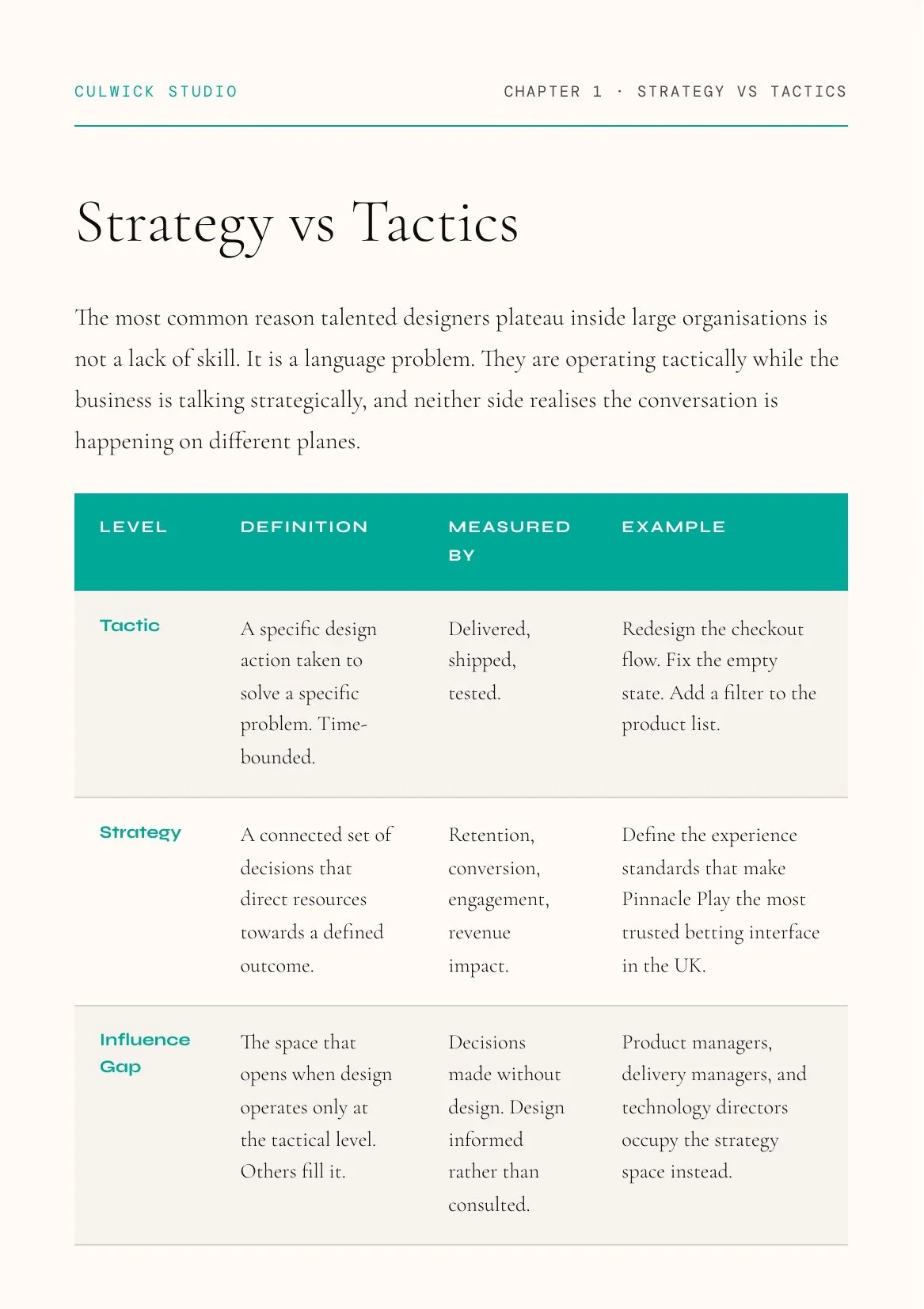 Image 2 of 3
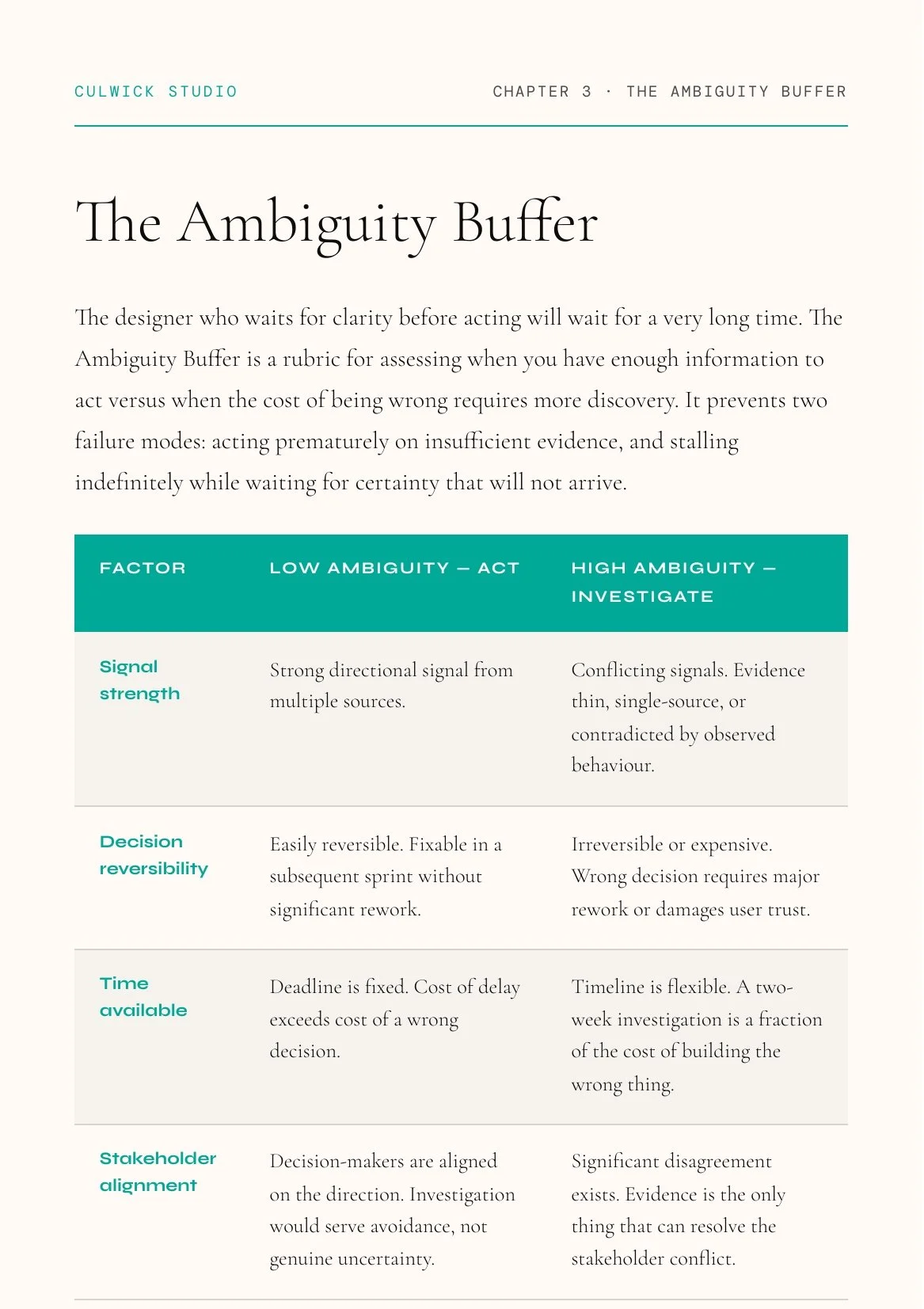 Image 3 of 3
Lead Designer Series — Playbook 04 of 08
Design strategy that operates at the level of business decisions, not design preferences.
Most design strategy fails at the translation layer. The thinking is sound. The frameworks are coherent. But somewhere between the design strategy document and the product roadmap, the strategic intent gets diluted — reframed as a nice-to-have, deprioritised against delivery pressure, or accepted in principle and ignored in practice. The strategy didn't fail because it was wrong. It failed because it couldn't hold its own in a room where decisions are made in business terms.
This playbook addresses UX strategy as an operational discipline — not a conceptual one. It covers how to define a north star that survives ambiguity, how to translate design intent into the commercial language that earns resource commitment, and how to maintain strategic coherence when the product direction shifts, the brief changes, or the stakeholders who signed off the strategy are no longer in post.
UX strategy is not a document. It is the set of decisions and communication disciplines that determine whether design has a consistent, compounding effect on the product over time — or is executed well in isolation and overridden at scale.
| Section | What it covers |
| Diagnostic | The Strategy Coherence DiagnosticComplete before reading — maps your current UX strategy against three alignment dimensions: north star clarity, business language, and operational continuity |
| Chapter 01 | What UX Strategy Actually Is — and Isn'tThe distinction between UX strategy, design vision, and product strategy; why conflating them produces documents that satisfy no one; what a working strategy has to do |
| Chapter 02 | Defining the North Star — The Alignment TreeHow to construct a north star statement that connects user outcomes to business outcomes; the three-level Alignment Tree structure; why north stars fail and how to build in the conditions for longevity |
| Chapter 03 | The Ambiguity BufferA four-dimension framework for operating with strategic confidence in conditions of high uncertainty — managing assumption risk, brief instability, stakeholder misalignment, and decision ambiguity without losing directional coherence |
| Chapter 04 | Prioritisation — Translating Strategy into DecisionsHow to use the north star as an active prioritisation tool; scoring frameworks for strategic alignment; how to make trade-off decisions defensible in cross-functional reviews |
| Chapter 05 | Value Translation — Speaking the Commercial LanguageThree translation layers — craft, delivery, and business — and how to move design decisions up the stack; the Value Translation framework for reframing UX decisions as risk, efficiency, and revenue arguments |
| Chapter 06 | The Lean Strategy DocumentHow to write a UX strategy document that gets read — structured around decisions, not principles; the format that earns stakeholder engagement rather than polite acknowledgement |
| Chapter 07 | Maintaining Strategy Through PivotsHow to absorb product direction changes without abandoning strategic coherence; the Pivot Trigger Framework; how to distinguish genuine strategic revision from scope drift dressed as strategy |
| Chapter 08 | Metrics — Making Strategy MeasurableThe Metrics Hierarchy for UX strategy; how to connect design decisions to leading indicators that are credible to product and commercial stakeholders; avoiding the trap of measuring what's easy rather than what matters |
| Appendix | Frameworks and TemplatesThe North Star Alignment Tree as a standalone working template; the Ambiguity Buffer rubric; the Value Translation framework; the Lean Strategy Document format |
- You're a senior or lead designer who owns the strategic direction of a product or product area
- Your design strategy gets agreed in principle and then quietly overridden in practice
- You find it harder to maintain design coherence across a programme than within a single project
- You need to present strategic design thinking to stakeholders who make decisions in commercial terms
- You're operating in a high-ambiguity environment and need a framework for holding direction without false certainty